
You can be a top-tier HVAC technician and still run a business that feels broke every Friday
Not because calls aren't coming in.
Because HVAC shop admin; pricing, invoicing speed, payment terms, and collections, quietly decides whether the shop can breathe.
A lot of great techs step into HVAC ownership thinking the hard part is “doing the work, but for yourself.” It’s not. The hard part is realizing the HVAC business can be busy, even profitable on paper, and still be one bad week away from a payroll panic.
That gap is almost always admin.
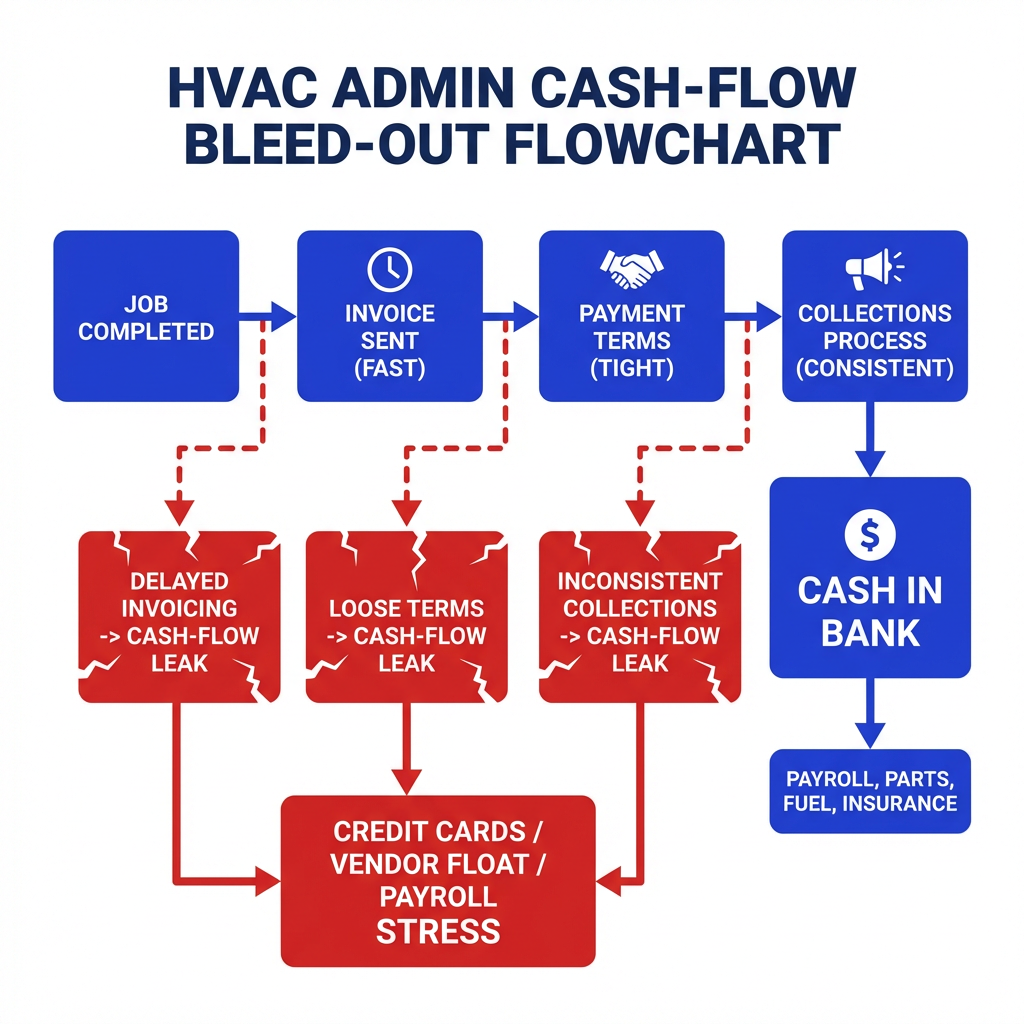
What do tech-to-owner HVAC transitions miss about admin?
They miss that HVAC ownership is a different job, not just turning wrenches with a new logo.
The hidden workload is constant:
- Pricing decisions (and re-decisions)
- Policy decisions (terms, deposits, warranty handling, change orders)
- Timing decisions (when invoices go out, how quickly cash comes in)
- Collections conversations (the ones you’d rather avoid)
As a technician, the job is fixing equipment.
When you have fewer than 10 people, every admin mistake lands on the owner, oftentimes at 9:30 p.m.
- The invoice you didn’t send becomes the vendor bill you can’t pay.
- The “we’ll figure it out later” pricing becomes the “why is there nothing left?” bank balance.
What financial literacy does an HVAC owner need?
You don't needto become a CPA, but you do need to know how money actually moves.
The fundamentals you can’t ignore:
Cost → pricing → gross margin
- If you don’t know true cost, pricing is a guess. “Competitive” often means “undercharging with confidence.”
Billing → collections → cash flow
- Billing asks for money. Collections gets the money. Cash flow is what hits the account, and when.
Credit/float → stress and payroll risk
- Sloppy invoicing and collections pushes the shop onto credit cards, lines of credit, and vendor terms. That is not growth. That is floating the business because customers are floating theirs on you.
A strong definition for HVAC owners: Know where the money is.
That’s not bookkeeping. That’s ownership.
A simple weekly scorecard:
- Cash balance (today, not last month)
- Accounts receivable aging (who owes money and how long it’s been)
- Invoice turnaround time (job done → invoice sent)
- Collected dollars vs. billed dollars (are you actually getting paid?)
Field-service software (FSM) can record this (Housecall Pro, QuickBooks, and others). Software won’t tell you what it means or force the decisions you’re avoiding.
Why do HVAC shop owners run out of cash even when revenue looks good?
Because cash flow isn’t revenue, and new HVAC owners get blindsided by timing.
Costs start immediately:
- Fuel
- Parts
- Insurance
- Payroll
- Tools
- Rent
- Software subscriptions
If payment terms are loose and invoicing is slow, the money shows up later, sometimes way later.
Profit on paper doesn’t pay payroll. Cash does.
Two questions matter:
- Do you have a business reserve (operating cushion)?
- Do you have personal runway?
When the shop stops relying on “it’ll work out next week,” decisions get sharper:
- Invoices go out faster
- Payment terms tighten
- Slow pay stops being treated as normal
- Cash gets protected
How should HVAC pricing be set?
HVAC pricing should be based on reality, not vibes.
A common trap:
- Pricing off competitors
- Undercutting an old employer
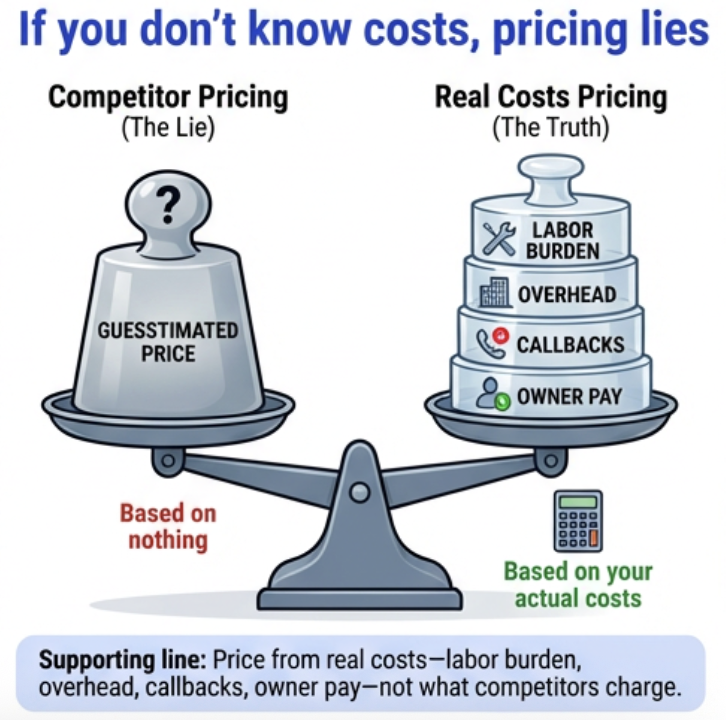
Example mindset: “My old company charged $100 an hour. I can do it for $80 and still win.”
Maybe, until you learn the old company might not know true cost either. Some long-running companies stay busy enough to hide the math.
A practical exercise:
- List every overhead cost
- Licenses
- Truck payments
- Insurance
- Phones
- Uniforms
- Software
- Shop supplies
- Marketing
- Accounting
- Interest
- Training
- Callbacks
- Bad debt
- Build the labor rate from the ground up
- Fully burdened labor (wage + payroll taxes + benefits)
- Overhead allocation
- Margin
Your labor rate is not just “what the market will bear.” It is what the HVAC business requires to survive.
Raising prices later is harder than starting right. Customers remember the number you trained them on.
What admin levers improve HVAC cash flow without hiring an office manager?
Start with policies and habits that pull cash forward. Switching software isn’t the always right fix.
What HVAC payment terms should small shops use?
Payment terms are a strategy, not a default setting.
“Net 30” is often inherited from a software template, not a strategic decision.
If you render the service today, your business does not need to act like a bank.
For many small commercial HVAC shops, switching to Net 10 (or due-on-receipt for certain work) is a simple cash-flow improvement.
How to do it without blowing up relationships:
- Apply new terms to new customers first
- Put terms clearly on estimates and invoices
- Use deposits or progress billing where it makes sense
- Negotiate from a stronger starting point (it’s easier to land at 15 when you start at 10)
.png)
How fast should an HVAC shop send invoices?
The moment you finish is the moment you should bill.
Delayed invoices = financing the customer.
A simple standard:
- Finished before noon → invoice out same day
- Finished after noon → invoice out next morning
Inside Housecall Pro (or any FSM), enforce with process:
- Require a closeout checklist before “job complete”
- Use automated send rules and cutoff times
- Require tech notes/photos so admin isn’t chasing details later
Every “I’ll send it later” becomes a cash-flow leak.
What is the difference between invoicing and collections?
Invoicing is sending the bill.
Collections is the system that gets the money.
“Sent” doesn’t mean “paid.”
Collections needs a repeatable escalation ladder:
- Day 1: receipt + friendly reminder
- Day 7/10: follow-up + confirm AP details (where does it get submitted?)
- Day 15: firm notice + pause future scheduling
- Day 30+: final step (late fees, collections, stop work)
Automate reminders, yes. But tyou should always know what is sitting in receivables and what is stuck.
.png)
How do big HVAC accounts damage cash flow?
Big accounts can turn your shop into the bank.
Volume feels good. The schedule fills up. Then terms stretch, payment delays, and the shop becomes dependent.
At some point you have to draw the line:
- Tighten terms
- Require deposits
- Reallocate labor toward customers who respect the business
If the relationship only works when you finance them, it’s not a relationship. It’s a liability.
How should an HVAC shop owner run the business before admin forces the issue?
Run the HVAC shop like a business before the business forces it.
If admin feels crushing and software feels like another job, don’t start by switching platforms. Start by choosing policies that control cash:
- Know costs
- Price to survive
- Invoice immediately
- Set intentional payment terms
- Run collections like a system—not a mood
Which one is hurting your business the most right now: pricing, invoice speed, or collections follow-through?
