

Running a small HVAC company means you're constantly splitting your attention between the field and the office, and neither side ever fully gets what it needs.
Automation and AI handle a large portion of the work that would otherwise take up your day. It makes everything a lot easier because the work keeps moving, even when your attention is elsewhere.
Here's how you can use AI to automate some of your day-to-day tasks:
What All of This Actually Changes Day to Day
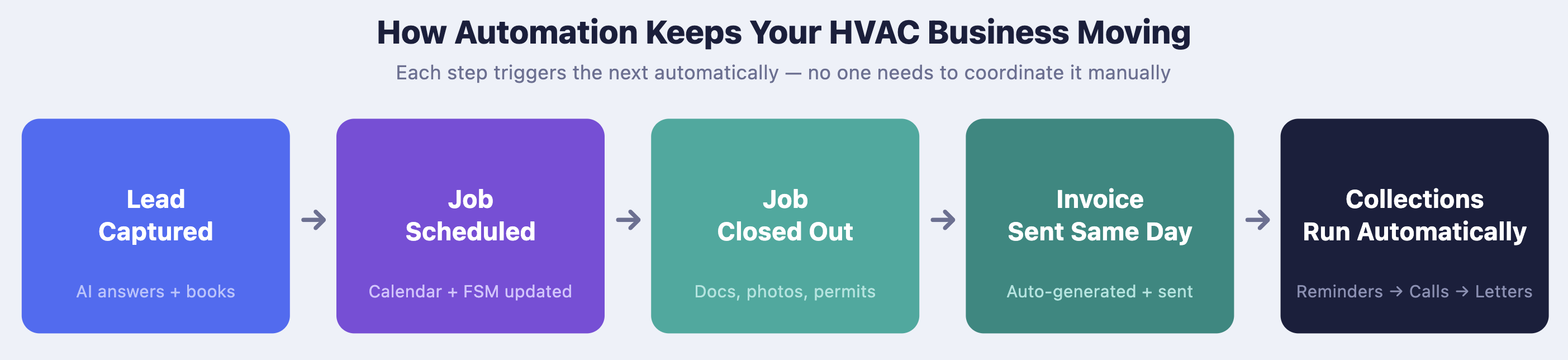
If you read through the sections below one by one, it can feel like a list of separate improvements, but in practice they work together. Each tool picks up where the last one leaves off.
A lead gets captured and followed up automatically. When it turns into a job, that job moves through a system where documentation is handled as the work is happening, not after the fact.
As soon as it's done, the invoice goes out without delay, and collections continue in the background if it's not paid. At the same time, your back office stays current and your pipeline stays visible without anyone manually pulling reports or checking in on every detail.
The point is, AI and automation can really improve how your business runs day to day, and more and more HVAC businesses are already starting to adopt these systems, which means the gap between shops that have this running in the background and those that don't is only getting wider.
Lead Capture & Follow-Up That Runs on Its Own
Leads that come in after hours are easy to lose. A call that goes to voicemail at 9pm on a Friday has a real chance of not becoming a job, and in most small shops there's no process in place to prevent that.
An AI customer service rep can handle inbound calls around the clock, answer common questions, and book the appointment without anyone needing to be available.
Follow-up doesn't have to be manual either, since field service management platforms can send a sequence of texts and emails automatically until the customer responds, so nothing gets overlooked.
When a customer accepts, the handoff can happen entirely through the system: the job gets created, the invoice generated, the calendar updated, and every downstream task, from permit applications to rebate processing to equipment registration, queued without anyone coordinating it manually.
Documentation, Closeout, and the Details That Cost You Later
Job closeout is where money tends to get lost in ways that aren't obvious until later. It's not usually one big mistake, it's the small details that don't get handled at the right time.
Things that need to be documented, submitted, verified, or followed through on, but end up depending on someone having the time to do it.
Many of these issues come down to verification, which a job completion verification workflow can catch before they become problems.
Once a job is marked complete, an automated checklist can confirm that all relevant inputs (photos, notes, homeowner info, manual J, etc.) exist.
AI can also handle the closeout process itself by taking over the paperwork. A technician writes their field notes the same way they always have, and AI rewrites them into a clean job invoice, for example. From there, the system can trigger the closing checklist automatically. No callbacks, no delays, no one chasing documentation at the end of the day.
Automation can also take over rebate processing. The workflow can trigger as soon as the job is marked complete. The system can detect what equipment was installed, pull model and serial numbers from job photos, check for available programs through Xcel, PSEG, and state-level rebates, and put together the application for a human to review before submission.
For contractors in states like Colorado or New York, where qualifying installations can mean hundreds to thousands of dollars in rebates, having an automated process catch and process those applications is what separates contractors who collect that money from those who don't.
The same approach works for warranty registration. The system can read the equipment photos, identify the OEM, whether that's Goodman, Carrier, Mitsubishi, or Trane, and create the registration task. The tech or office uploads to the manufacturer portal and logs the confirmation back into the job record. This is one of the remaining manual steps, but it's already moving toward automation.
Most small contractors skip this step entirely, which eventually means customers discovering they lost warranty coverage they thought they had.
For permit-eligible jobs, the workflow can pull the scope of work, identify the municipality, locate the portal, and assemble the application details. Status updates can flow to a central tracker and documents get filed in Drive, linked directly to the job.
If you've dealt with any of these gaps before, AI and automation can take that entire layer of work off your plate and make sure it actually gets done.
Invoicing and Collections
Every day between a completed job and a sent invoice is a day the payment clock hasn't started. At low volume that's manageable. At higher volume, those delays start stacking into a real cash flow problem.
Automated invoice creation can close that gap by generating the invoice as soon as the tech wraps up and submits notes and photos. Simple jobs can be invoiced and sent automatically. More complex jobs can be flagged for review before going out.
Either way, the invoice isn't sitting in a queue waiting for someone in the office to find time for it.
When it comes to collections, this is where money tends to slip through the cracks. Time and time again, we've seen contractors leave money on the table, not because they don't care, but because there's no system consistently following up.
An automated accounts receivable tracker can monitor outstanding balances and run a collections playbook at defined intervals, starting with email reminders, escalating to calls at 30 days, and moving to formal letters at 90 days.
One contractor had $18,000 in past-due balances that nobody was actively following up on, not out of negligence, but because there was no process running in the background to flag it and keep pushing.
That's exactly the gap a semi-automated AR process fills.
Back Office Work That Stays Up to Date Automatically
The back office is where a lot of the ongoing work sits. It's not one big task, it's a steady stream of smaller things that need to be handled and kept up to date.
Most of it doesn't feel urgent, but over time it adds up and starts affecting how the business runs. Without a system in place, it all depends on someone staying on top of it, and that's where things start to slip.
Parts ordering is a small but persistent drain. When a tech needs a part, they send the part number, AI can check supplier sites and return the best price, and the owner approves with one click.
What usually involves back-and-forth messages and manual price comparison gets compressed into a single action.
The price book is foundational to accurate invoicing and job costing, and it's one of the things most small shops under-maintain over time.
Vendor catalogs from Ferguson, Johnstone, and other suppliers can be linked directly into the FSM so material costs update from vendor feeds automatically. Markup structures get managed at the system level rather than being edited job by job in the field, which is typically where margin starts to erode quietly.
That same idea carries over into job costing. When QuickBooks is properly synced with the FSM, every completed job shows real margin rather than a rough estimate you revisit at year-end, with purchase orders from supply houses matched directly to the jobs they belong to.
Pair that with weekly reporting delivered to the owner's inbox, covering jobs run, estimates sent, conversion rate, and revenue per tech, and you have ongoing visibility without anyone manually pulling numbers.
On top of that, AI connected to your FSM or CRM can surface what actually needs attention. Open estimates, unconverted leads, customers due for maintenance, all of it gets pulled into a clear, actionable view without anyone having to dig through the system.
Recurring Revenue & Visibility
AI and automation can take over the systems behind recurring revenue and visibility, so they keep running without constant input.
Maintenance plan management through platforms like Housecall Pro or ServiceTitan can add structure to recurring revenue that most shops don't have.
Renewal tracking, seasonal scheduling, and payment workflows can run automatically, with reminders going out to customers ahead of their visits, so the operational overhead that causes most membership programs to quietly lapse gets handled by the system instead of by whoever happens to remember.
There's also a content side that doesn't require much to keep running. Techs text job photos from the field, and from those photos, content can be drafted and scheduled across Facebook, Instagram, and Google Business Profile two to three times a week, keeping the owner visible locally without writing a single caption or logging into a single platform.
Where to Start
None of this requires building everything at once. For most shops, the right starting point is wherever time is leaking the most, and that's usually one of three places: invoicing, accounts receivable, or estimate follow-up.
Those three areas have a direct impact on cash flow and tend to break first when there's no system behind them. Invoices go out late, follow-ups don't happen consistently, and money sits uncollected longer than it should.
Fixing just one of those changes how the business feels day to day.
The contractors pulling ahead aren't doing everything differently. They've just stopped handling manually the parts of the business that don't need their time anymore.
Let Us Handle Your Back Office Operations
Everything described in this article is achievable, but it only works if someone is actually responsible for running it.
The workflows don't break because they're complex, they break because no one has the time to stay on top of them consistently. That's where things start to slip.
What WorkHero does is take over that layer of the business. Instead of you setting up and managing all of these processes yourself, you have a team that handles the same work across the areas that tend to create the most friction.
These are the exact points in the workflow where things either move forward consistently or get delayed.
You're not replacing your operation or changing how you run jobs. You're removing the need to manage the administrative side of it yourself, so the work continues to move even when your attention is somewhere else.
Join the HVAC Owners Who Are Breaking Free from Administrative Burdens!
