

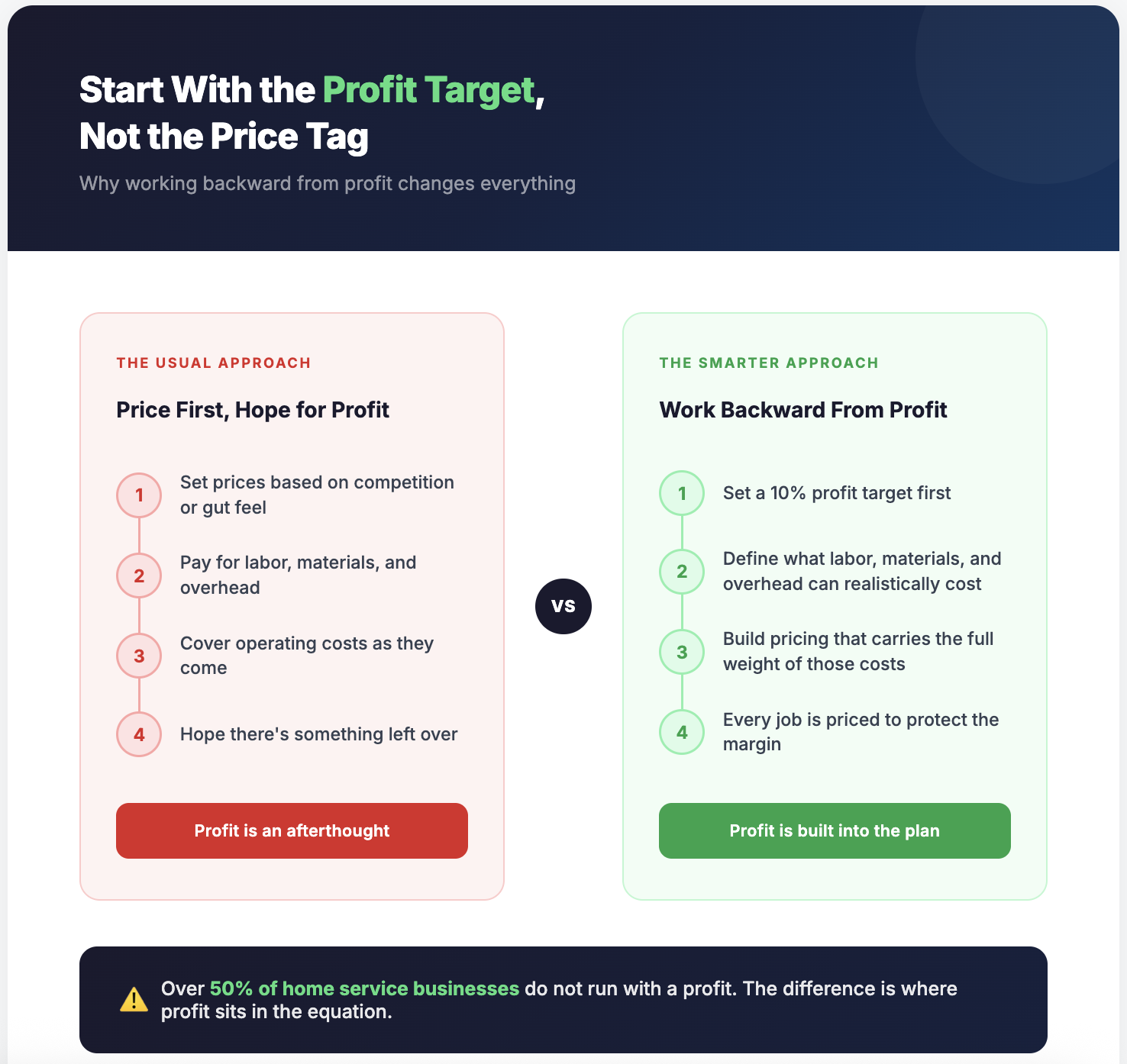
Most home service businesses lose profitability well ahead of it showing up on a year-end report. Over 50% don't run at a profit, largely because they lack the accounting foundations to track what each job actually costs, what margins they're earning, and whether pricing covers full overhead.
The problem isn't sales volume. It's that accounting gets treated as basic bookkeeping and tax prep rather than a system that drives profitability. Sustainable growth starts when a business works backward from a profit goal, captures job-level costs correctly, and builds a price book that turns real numbers into consistent pricing.
Why does home service business profitability depend on gross margin?
Home service business profitability depends on gross margin because gross margin is what pays for everything else in the business. If the gross margin is not there at the beginning, growth creates pressure instead of stability. As the business adds another staff member, an office staff member, and marketing costs, underpricing gets exposed. The owner then realizes pricing may need a major correction just to support the structure that has already been built.
Start with the profit target and build your budget backward, instead of pricing first and hoping there's something left over.
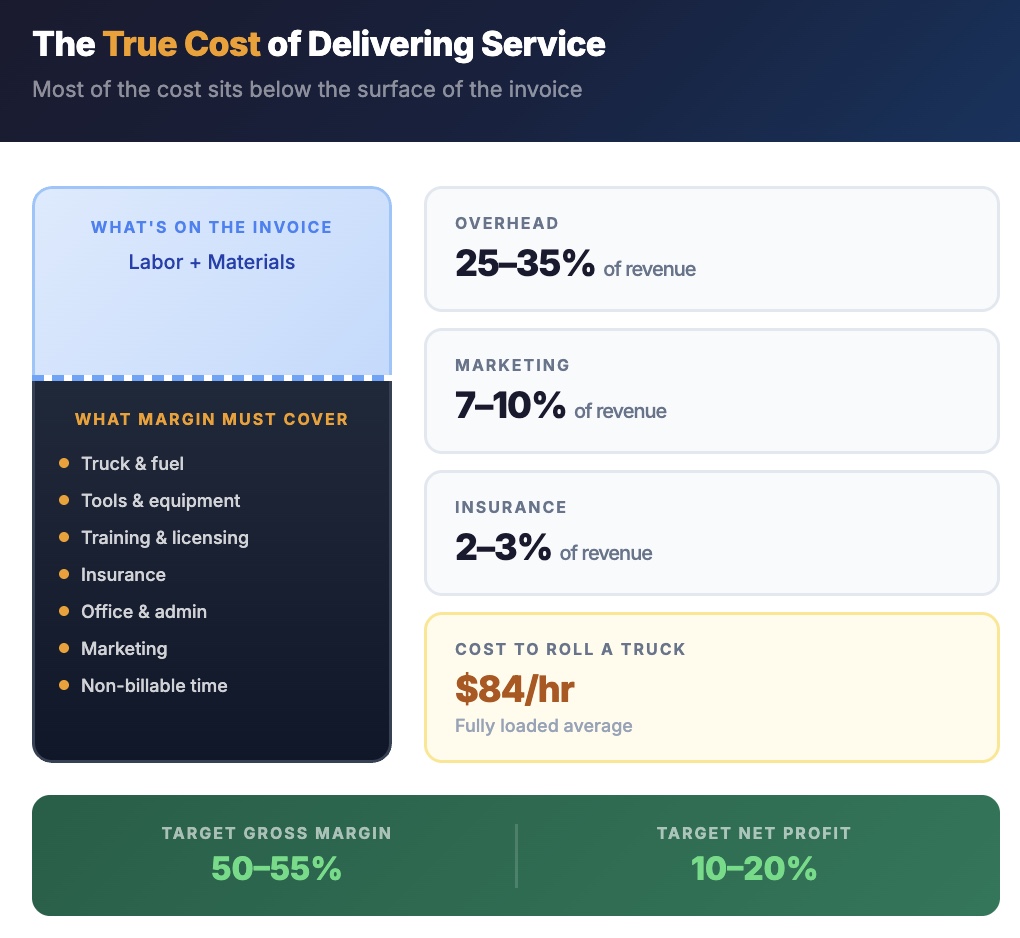
This also matters because customers usually see only the visible part of the service call. They may see a technician at the door and one part being replaced. What they do not automatically account for is the truck, the truck insurance, the truck wrap, the tools in the truck, the training behind the technician, and the insurance attached to the visit. Those costs are real, and gross margin is what carries them.
When gross margin awareness is missing, the business can look busy while still falling behind. Revenue alone does not solve that. If the work is priced without enough margin, every added job can deepen the problem.
Where This Commonly Breaks Down
This usually breaks down when pricing is based on what feels acceptable in the moment instead of what the business needs to earn. It also breaks down when owners treat accounting as invisible and see it only as bookkeeping plus tax filing at year end.
Another common problem is scaling before the gross margin target is understood. The business hires, adds office support, and spends on marketing without proving that the current pricing can support those costs. At that point, the gap between sales and profit becomes much harder to close.
How an Experienced HVAC Office Manager Handles It
An experienced HVAC office manager starts with the profit target and works backward into the budget. That process clarifies what has to be left over for labor, materials, and operating expenses after profit is accounted for.
They also make sure pricing reflects the full cost of delivering service, not just the visible part on the invoice. The truck, tools, training, insurance, office support, and marketing all have to be supported by margin. When those costs are recognized early, the business can scale on purpose instead of discovering too late that revenue was never producing enough room for growth.
How does job costing improve home service business profitability?
Home service business profitability improves when job costing captures every cost attached to the work. Job costing is not limited to parts and direct labor. It includes drive time, fuel, booties, tarps, labor, and other costs tied to completing the job. Without that visibility, pricing decisions are built on incomplete information.
This is why field service management software is recommended as the place where job level costs are captured before they flow into accounting. If the data is not collected at the job level, accounting has less to work with later. The result is a financial picture that may look organized on the surface but does not show what each type of work is truly producing.
In practical terms, job costing creates the link between field activity and financial reality. It tells the business whether the work being sold is actually supporting the margin it expects.
Where This Commonly Breaks Down
This breaks down when owners capture only the most obvious costs and ignore the smaller items that keep repeating across jobs. Drive time, fuel, and consumables may seem minor in isolation, but they matter when the business wants to know true job cost.
It also breaks down when the owner resists software and relies on year end accounting to reveal performance. By that point, pricing and process mistakes have already repeated many times.
How an Experienced HVAC Office Manager Handles It
An experienced HVAC office manager builds job costing around complete cost capture. They make sure labor, travel related costs, and job consumables are recorded where the work happens so those numbers can move into accounting accurately.
They also evaluate the cost of software against the margin being missed without it. If better job costing helps recover even one underpriced job, the software cost can be justified quickly. Most importantly, they do not wait until tax season to discover bookkeeping problems. They use job level data to keep the financial picture useful throughout the year.
How does a price book protect home service business profitability?
A price book protects home service business profitability because it turns costs and margin targets into calculated pricing. Without a price book, pricing can swing between underpricing and gouging. With a price book, the price is not arbitrary. It is built from known costs and the gross margin the business needs to support itself.
A clear HVAC example shows why this matters. For a basic 2 tonne unitary AC unit, a capacitor may cost about $5 to $25 from a supply house. If material is $25 and one hour of labor is valued at $100, the total cost is $125. At a 50% gross margin, the selling price would be $250. At a 60% gross margin, the $125 cost is divided by 0.4, which produces a price of $312.50.
That math creates a defensible price. It shows the difference between a calculated selling price and a number chosen without structure. It also explains why customers react strongly when they hear that some companies charge $1,200 for the same capacitor replacement. A price book built from cost and margin reduces both extremes. It helps prevent the business from undercharging, and it also helps avoid prices that damage trust.
A price book is especially useful for technicians planning to start their own business. One practical approach is to begin reverse engineering job costs now. Watch what the current employer charges, estimate labor from the known hourly rate and the time spent on the job, and use the difference to approximate material cost. That process gives a starting point for understanding how pricing is assembled before the business is launched.
Pricing discipline is not about guessing what the market will tolerate. It is about connecting job cost to gross margin in a repeatable way.
Where This Commonly Breaks Down
This usually breaks down when prices are set from memory, urgency, or comparison without real cost math behind them. It also breaks down when the owner looks only at the part cost and ignores the business costs that arrive with the technician at the door.
In that environment, the business either undercharges and loses margin or lands at numbers that feel disconnected from the work being performed.
How an Experienced HVAC Office Manager Handles It
An experienced HVAC office manager uses a price book to anchor pricing in job cost and gross margin. They take the actual cost structure, apply the target margin, and turn that into a selling price that can be explained and repeated.
For businesses still building their systems, they can also reverse engineer pricing by looking at what is charged today, estimating labor based on hourly rate and time on job, and backing into likely material cost. That creates a path from observation to a structured price book instead of relying on guesswork.
FAQ
Why are so many home service businesses not profitable?
The main reasons identified are weak accounting foundations, missing job costing, poor gross margin awareness, and pricing that is not built from a structured price book.
What should be included in HVAC job costing?
HVAC job costing should include every cost associated with the job, not just parts and labor. That includes drive time, fuel, booties, tarps, and labor before the information flows into accounting.
How do I know which part of my HVAC business is losing money?
Departmentalize the profit and loss statement so service and install are separated, or commercial and residential are separated. That shows which part of the business is underperforming instead of hiding the issue inside one blended revenue number.
When should I bring in bookkeeping or CFO help?
Around half a million in revenue is the point where bringing in a fractional bookkeeper or having a CFO review the financials is recommended. Waiting until tax time can leave bookkeeping problems hidden until much later.
Conclusion
Home service business profitability is built on visibility. Gross margin has to be strong enough to pay for the rest of the business. Job costing has to capture the real cost of each job. A price book has to turn those costs into calculated pricing instead of guesses. When those systems are missing, a business can stay busy and still fail to produce profit. When they are in place, the owner can budget backward from profit, price work with confidence, and see where the business is actually performing. In HVAC, that foundation matters before growth, not after it.
Meta description: Home service business profitability improves when HVAC companies use job costing, gross margin targets, and price books built from real costs
