

Key takeaways
- Admin bottlenecks are an office-capacity problem: Scheduling gaps, slow invoicing, missed follow-ups, and unfiled permits consistently trace back to having no dedicated person running the back office, and small shops lose an estimated $100,000 a year in billable time to unmanaged admin work, according to HVAC Industry Pulse 2025 survey findings.
- The costliest scenario isn't a single missed invoice: When the one person handling the back office leaves, scheduling, billing, and customer communication all stop at once. That staffing-gap crisis is a named, recurring situation for small HVAC shops, not a rare edge case.
- Fixing these gaps doesn't require new software or a full-time hire: HVAC-native admin support works inside the tools a shop already uses, Jobber, HouseCall Pro, ServiceTitan, QuickBooks, and has produced documented results including 7.5x faster invoicing and a 99% billing success rate across 1,565+ tracked jobs.
According to the HVAC Industry Pulse 2025 survey findings, shops with 1 to 10 employees average 15.4 administrative hours per week, with quoting, scheduling, invoicing, and permit filing ranking as the most time-consuming tasks. At a $120 billable rate, that burden adds up to nearly $100,000 in lost revenue annually.
For most 2 to 4 truck owners, those hours aren't going to a dedicated office person. They're going to the owner, after hours, on weekends, between jobs. This article breaks down where each bottleneck actually comes from and what a dedicated HVAC administrative support setup does to close the gap.
What Is HVAC Administrative Support, and Why Does It Matter for Contractor Operations?
HVAC administrative support covers the back-office work that keeps a shop running between jobs: sending quotes, issuing invoices, scheduling and dispatching, following up with customers, filing permits, submitting rebates, and registering equipment. For a 2 to 4 truck owner who is also the lead tech, the de facto dispatcher, and the person answering the phone, these tasks don't disappear. They just get pushed to nights and weekends.
The core problem isn't that the field work is too slow. It's that the gap between completing a job and getting paid for it has no dedicated owner. A tech finishes an install on Thursday afternoon. The invoice doesn't go out until Sunday night. The rebate paperwork sits in a folder for two weeks. That delay isn't a field problem; it's an office-capacity problem. To understand how a dedicated HVAC back office works in practice, the model starts with plugging into the shop's existing software and auditing where those gaps are actually occurring, rather than assuming the answer is more hours from the owner.
Where Do HVAC Scheduling and Dispatch Gaps Actually Come From?
Scheduling gaps happen when the person managing the dispatch board is also installing equipment, answering customer calls, and approving supply orders. No single person can do all three consistently without jobs slipping.

- Split attention creates double-bookings: When the owner is on a job site and a customer calls to reschedule, that change often doesn't make it into the system until the end of the day, by which point a tech may already be routed incorrectly.
- No one owns the board full-time: In shops without a dedicated dispatcher, the schedule gets managed reactively. Jobs get booked, but follow-up confirmations, parts lead times, and permit clearances don't get checked against the calendar before a crew rolls out.
- The fix isn't new software: Jobber, HouseCall Pro, and ServiceTitan already have the scheduling infrastructure most shops need. The gap is a person working inside that tool every day, not a different tool. HVAC software setup and workflow automation addresses this by configuring the existing system to match how the shop actually runs, then keeping it current.
- Dispatcher roles carry real market value: Dedicated dispatch support runs $1,300 to $1,800 per month in the broader VA market, which reflects how recognized and priced this function is. The question isn't whether the role matters; it's whether someone is actually filling it in your shop.
Why Do Customer Follow-Ups and Service Administration Slip Through the Cracks?
Customer follow-ups slip because the owner is in the field when they need to happen, and there's no system catching what doesn't get done.
- Quotes go out late or not at all: A customer asks for a replacement quote on a Friday afternoon. The owner is on a job until 5pm, gets home, handles payroll questions, and the quote doesn't go out until Monday. By then, a competitor may have already responded.
- Maintenance plan renewals expire quietly: Without someone actively monitoring expiring agreements, customers roll off plans without a renewal conversation. That's recurring revenue that disappears without a visible cancellation event. Proper maintenance plan enrollment and renewals tracking catches failed payments and expiring terms before they become lost members.
- Callback lists don't manage themselves: When a tech notes a secondary issue on a job and the customer says "call me next week," that follow-up needs to live somewhere with an owner. If it lives only in the tech's memory or a sticky note, it doesn't happen.
- All of this runs inside the existing CRM: None of these tasks require a new platform. They require someone checking the system daily and executing the follow-up workflow that's already built in.
How Do Invoicing and Bookkeeping Delays Quietly Drain HVAC Cash Flow?
Invoicing delays drain cash flow because completed work that isn't billed promptly doesn't just slow payment, it creates an AR backlog that compounds week over week.
- Invoices sit in draft while cash flow suffers: The HVAC Industry Pulse 2025 survey findings rank invoice processing among the top five most time-consuming admin tasks for small shops. When no one owns the billing queue, jobs pile up unbilled and the owner doesn't know what's outstanding until the bank account gets tight.
- AR follow-up is inconsistent without a dedicated owner: Sending an invoice is one step. Following up on unpaid invoices at 15, 30, and 45 days is a separate workflow that most owners handle reactively, if at all. See the HVAC collections playbook for faster payment for how that follow-up sequence should be structured.
- Named results show what changes with ownership: Just Right Mechanical and ABL Comfort Solutions are two documented examples of what happens when billing gets a dedicated owner. Their results are covered in the case studies below.
- The billing function needs end-to-end ownership: Invoicing and collections management covers the full cycle, from same-day invoicing through AR cleanup and expense reconciliation, not just sending the initial invoice.
Case study: Just Right Mechanical
Just Right Mechanical, a 9-person HVAC company, was growing but its billing had no clear owner. A part-time office manager was leaving, a VA was handling miscellaneous admin, and neither had full accountability for invoicing accuracy, timing, or collections. Invoices sat unissued. Follow-ups were manual and inconsistent. AR visibility was limited.
After taking over billing end to end, invoice volume increased by 700% compared to the prior 30 days, on-time payments rose 138%, and payments came in 48% faster. The change wasn't a new software platform. It was consistent ownership of the billing workflow from job completion through collection.
Case study: ABL Comfort Solutions
ABL Comfort Solutions runs commercial HVAC service across 10+ Boston-area properties, handling 150+ service calls per month at peak. The billing challenge wasn't volume alone. Each property manager used a different invoicing portal, PO system, and payment schedule, making reconciliation nearly impossible without a centralized system.
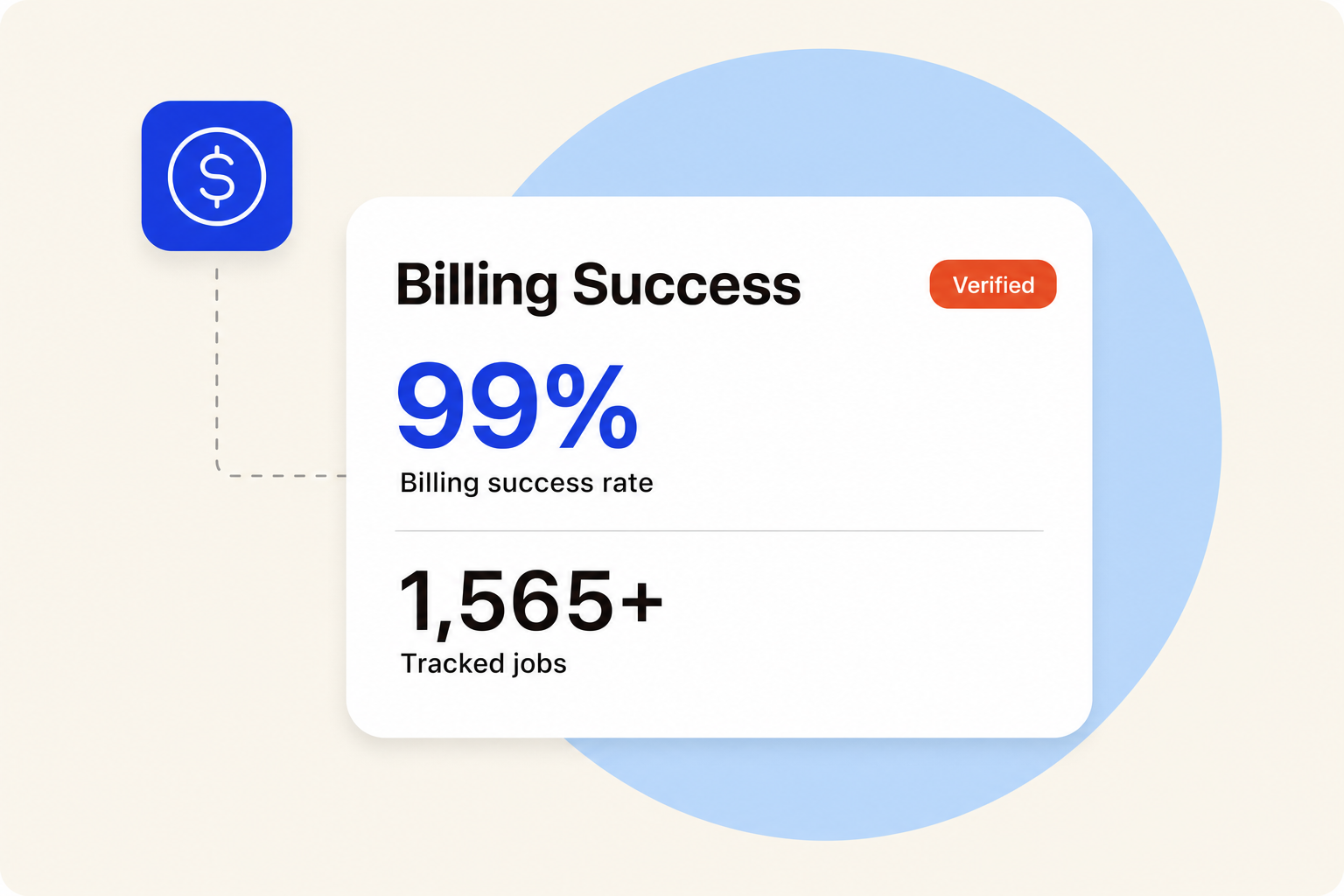
With a custom billing automation built inside HouseCall Pro and a dedicated back-office team managing reconciliation, ABL tracked 1,565+ service jobs and achieved a 99% billing success rate. That result demonstrates what HVAC administrative support looks like when the complexity extends beyond simple residential invoicing into multi-property commercial billing.
What Happens When Your Only Admin Person Quits?
When the one person handling the back office leaves, every admin function stops at once. Scheduling, invoicing, customer communication, and permit tracking all lose their owner on the same day.
This isn't a hypothetical. It's one of the most common inflection points for small HVAC shops. The owner absorbs the work temporarily, which means field time drops, invoices get delayed, and permit filings pile up because no one is watching the deadlines. Permit and rebate paperwork tends to accumulate fastest during a staffing gap because it has no natural urgency until a jurisdiction pushes back or a rebate window closes. Detailed coverage of what that paperwork function involves is at HVAC permits and registrations support.
The broader labor context makes this more acute. According to the 2026 HVAC contractor workforce risk survey, 35% of commercial contractors cite labor concerns as the top risk heading into 2026. For small shops, that risk isn't just about field technicians. It's about the single admin person whose departure can stall the entire back office. A fully managed admin partner absorbs that shock without the owner having to recruit, interview, onboard, and retrain a replacement while simultaneously running the field.
How Does Virtual Assistant Support Compare to HVAC-Native Admin Help?
Small HVAC shops evaluating admin support typically have four options: field service management software, hourly VA services, staffing agencies, and HVAC-native managed admin partners. Each works differently, and the differences matter for how much the owner still has to manage.
- Software platforms (Jobber, HouseCall Pro, ServiceTitan): These tools manage job data, scheduling, and invoicing workflows. They don't execute the work. Someone still has to open the platform, process the invoice, file the permit, and follow up on the unpaid balance. Software is infrastructure, not a back-office function.
- Hourly VA services: Generic virtual assistants execute tasks assigned to them. They typically need direction on what to do, training on HVAC-specific workflows (permit portals, rebate programs, FSM software), and ongoing management from the owner. Market rates run $7 to $18 per hour depending on specialization, or $1,299 to $2,500 per month for flat-rate plans. The owner still owns the outcomes.
- Staffing agencies: A staffing agency places a person you hire and manage directly. You carry the recruiting cost, the ramp time, and the turnover risk. When that person leaves, you're back at the beginning.
- HVAC-native managed admin partners: A fully managed model means training, oversight, and execution are handled by the provider. The admin partner works inside the shop's existing software, already knows HVAC workflows (permit jurisdictions, rebate portals, FSM platforms), and owns outcomes rather than waiting for task assignments. For how automation fits into this model, see AI and automation in HVAC admin workflows. WorkHero operates this way: a dedicated HVAC-expert office manager supported by AI handles repetitive, document-heavy tasks at speed, while a human stays accountable for quality and edge cases.
How Do You Build Business Operations Management That Scales With a 2 to 4 Truck Shop?
Business operations management at this scale means getting the right systems in place and keeping them current as the business changes, not installing a one-time template and walking away.
According to small HVAC business admin burden data, 44% of contractors employ 5 or fewer employees and 69% employ 20 or fewer. The 2 to 4 truck shop isn't an edge case; it's the industry norm. Operations support built for this scale should follow a practical sequence:
- Plug into existing systems: Connect to the FSM platform, QuickBooks, and email the shop already uses. Audit current workflows to identify where jobs are getting stuck, where invoices are delayed, and where the owner is still doing work that shouldn't require them.
- Prioritize the highest-impact bottlenecks first: In the first 30 to 60 days, that typically means billing and AR cleanup, permit and rebate backlogs, and making sure the FSM platform is configured to match how the shop actually dispatches and closes jobs.
- Build SOPs so processes don't live in one person's head: Job closeouts, hiring steps, training checklists, and HR policies get documented so the business can run consistently even when personnel changes.
- Set weekly check-ins to stay aligned: A short weekly review keeps priorities current as the business changes. Seasonal surges, new service lines, and staffing shifts all affect what the back office needs to handle. Weekly check-ins are the mechanism that keeps admin support calibrated to the business rather than running on a fixed scope that no longer fits.
How Do You Know HVAC Admin Support Is Actually Working?
The clearest signals are operational, not abstract: invoices go out the same day jobs close, AR aging stays current, permits are filed before installs, and the schedule stays full without the owner managing the dispatch board personally.
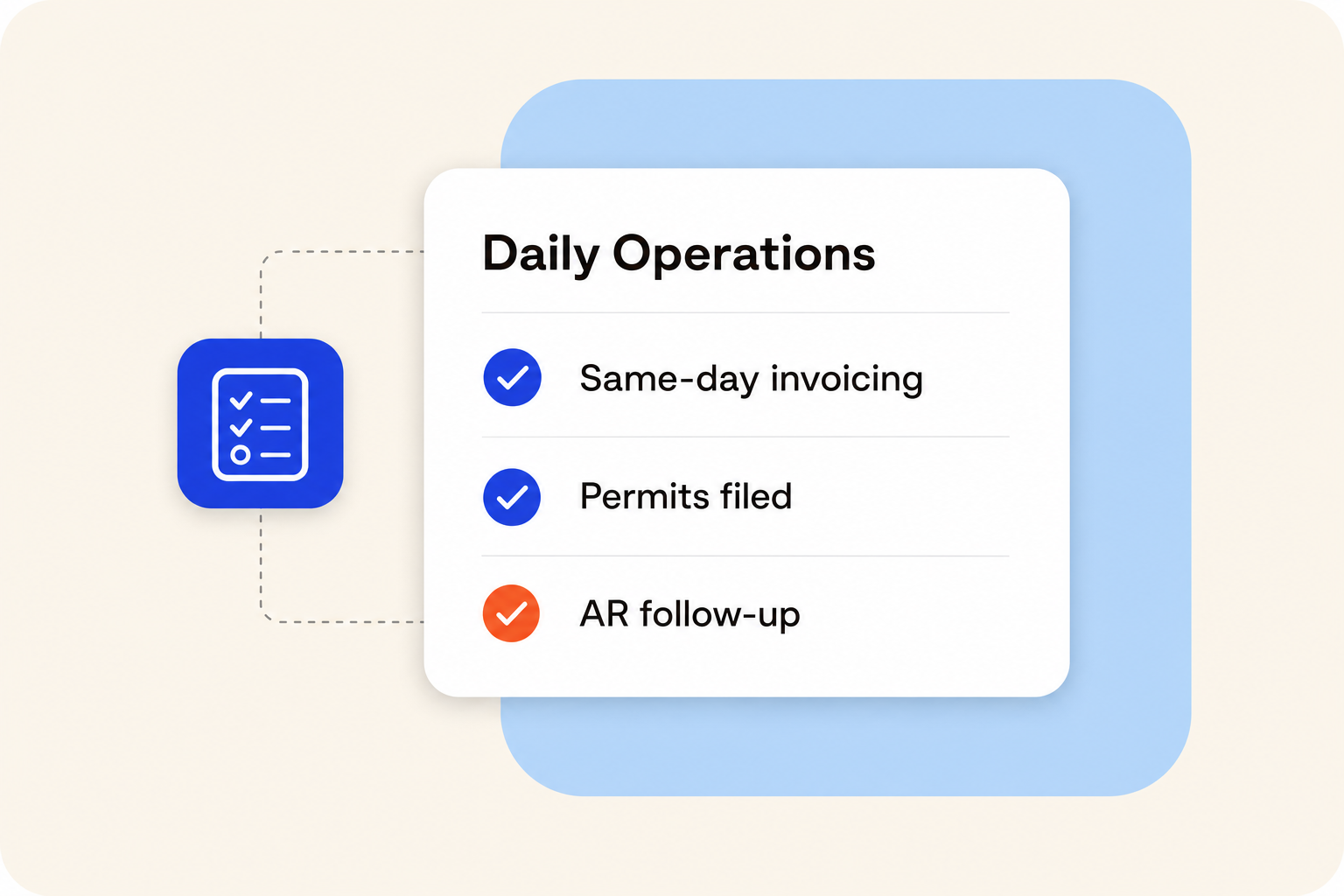
- Same-day invoicing replaces the draft backlog: If completed jobs are sitting unbilled for more than 24 hours, billing ownership hasn't fully transferred. The target is invoices out the day the job closes.
- AR aging stops growing: A current AR report with consistent follow-up at 15, 30, and 45 days is a concrete indicator that collections are being managed, not just monitored.
- Permits and rebates hit deadlines: Jurisdiction deadlines and utility rebate windows don't move. If paperwork is getting filed on time without the owner tracking it personally, the admin function is working.
- The owner stops doing admin at night: This is the practical test. According to admin burdens shaping home service businesses, administrative load is one of the defining daily challenges for U.S. home-service operators. When that load shifts off the owner's plate, evenings and weekends change.
- Reported aggregate results give a benchmark: WorkHero's own figures, 92% customer satisfaction, an average of 20 hours per week saved, and 60% cost savings compared to in-house staff, reflect what this model has produced across its client base. These are the provider's reported outcomes, not a guarantee for any individual shop, but they give a reasonable reference point for what a well-run HVAC admin function can deliver.
Bottlenecks get fixed by a real person who already knows HVAC operations, not by adding another subscription or working longer hours. The weekly check-in is what keeps that person aligned with where the business actually is, not where it was when they started.
