

Key takeaways
- Call answering isn't enough: Virtual office management services that only handle phones and messages don't touch the HVAC-specific admin work, such as permits, rebates, and equipment registration, that keeps small shop owners working nights and weekends.
- Three realistic alternatives exist: Small HVAC contractors running 2 to 4 trucks can choose from generalist VAs, virtual reception services, or an HVAC-native fully managed service, each with different pricing, ownership models, and trade-offs.
- No platform switch required: A fully managed HVAC back-office service works inside the tools you already run, including Jobber, HouseCall Pro, QuickBooks, and ServiceTitan, and is priced month-to-month, typically well below the $50K-plus annual cost of an in-house office manager hire.
According to the HVAC Industry Pulse 2025 survey findings, 44% of HVAC contractors employ five or fewer people, and 69% have 20 or fewer. Most of those owners are personally handling scheduling, invoicing, permits, and rebates after hours because they haven't found support that actually understands HVAC operations.
This article breaks down what virtual office management services actually cover, where they fall short for HVAC contractors, and what your real options look like as a small shop, including what each option costs, who runs the work, and what you're still responsible for when the day is done.
What Is Virtual Office Management for HVAC Contractors?
In most industries, "virtual office management" means call answering, calendar management, and basic inbox support. For HVAC contractors, that definition misses most of the actual work.
Small HVAC shops, which make up the overwhelming majority of the industry per the HVAC Industry Pulse 2025 survey findings, spend an average of 15 to 20 hours a week on billing, rebates, permits, and other admin tasks. That's not a phone-answering problem. It's a back-office execution problem that requires someone who knows what a rebate portal looks like, what a permit jurisdiction expects, and how to close out a job correctly inside Housecall Pro or ServiceTitan.
When contractors search for virtual office management services, they're often hoping to find something that handles all of that. What they typically find instead are services built for law offices and real estate agents, not for shops running installs across multiple jurisdictions with manufacturer registrations due at job closeout. Understanding how managed HVAC back-office works is a useful starting point for seeing what the category actually looks like when it's built for this industry specifically.
Why Isn't a Virtual Receptionist Enough for HVAC Admin?
Generic virtual office and reception services handle front-desk functions: answering calls, taking messages, providing a business address, and routing inquiries. Those services were designed for professionals who need a polished phone presence, not for contractors who need permits filed before an install crew shows up on-site.
The ACCA Contractor of the Future study highlights, which surveyed more than 1,000 HVACR contractors about their business practices and operations, points to back-office execution as a persistent operational gap for small shops. Call answering doesn't close that gap. When a rebate application requires QI forms, AHRI certifications, geo-tagged photos, and multi-portal submissions, a message-taking service has nothing to offer.
The distinction matters practically. An owner who signs up for a virtual office service to reduce their admin burden will still come home to a stack of permit filings, an AR report that nobody touched, and equipment registrations that expired because no one caught the deadline. Front-desk coverage and back-office execution are two separate functions, and most virtual office services only deliver one of them.
What Does Virtual Admin Support for HVAC Contractors Actually Include?
Purpose-built HVAC admin support covers the full range of back-office work that keeps a small shop compliant, paid, and operational. The task list goes well beyond scheduling and inbox management.
- Scheduling and dispatch coordination: Jobs get booked, technicians get routed, and the schedule stays current inside your field service management software without the owner manually managing it.
- Invoicing and collections: Completed jobs get invoiced the same day, AR gets followed up consistently, and past-due accounts get structured payment terms. Just Right Mechanical saw a 7x increase in invoice volume, a 48% improvement in payment speed, and a 138% increase in on-time payments after handing off billing end-to-end. See more on HVAC invoicing and collections management.
- Permit filings and inspections: Permits get filed with the correct building department ahead of installs, inspections get tracked through completion, and portal submissions are handled without the owner calling the building department.
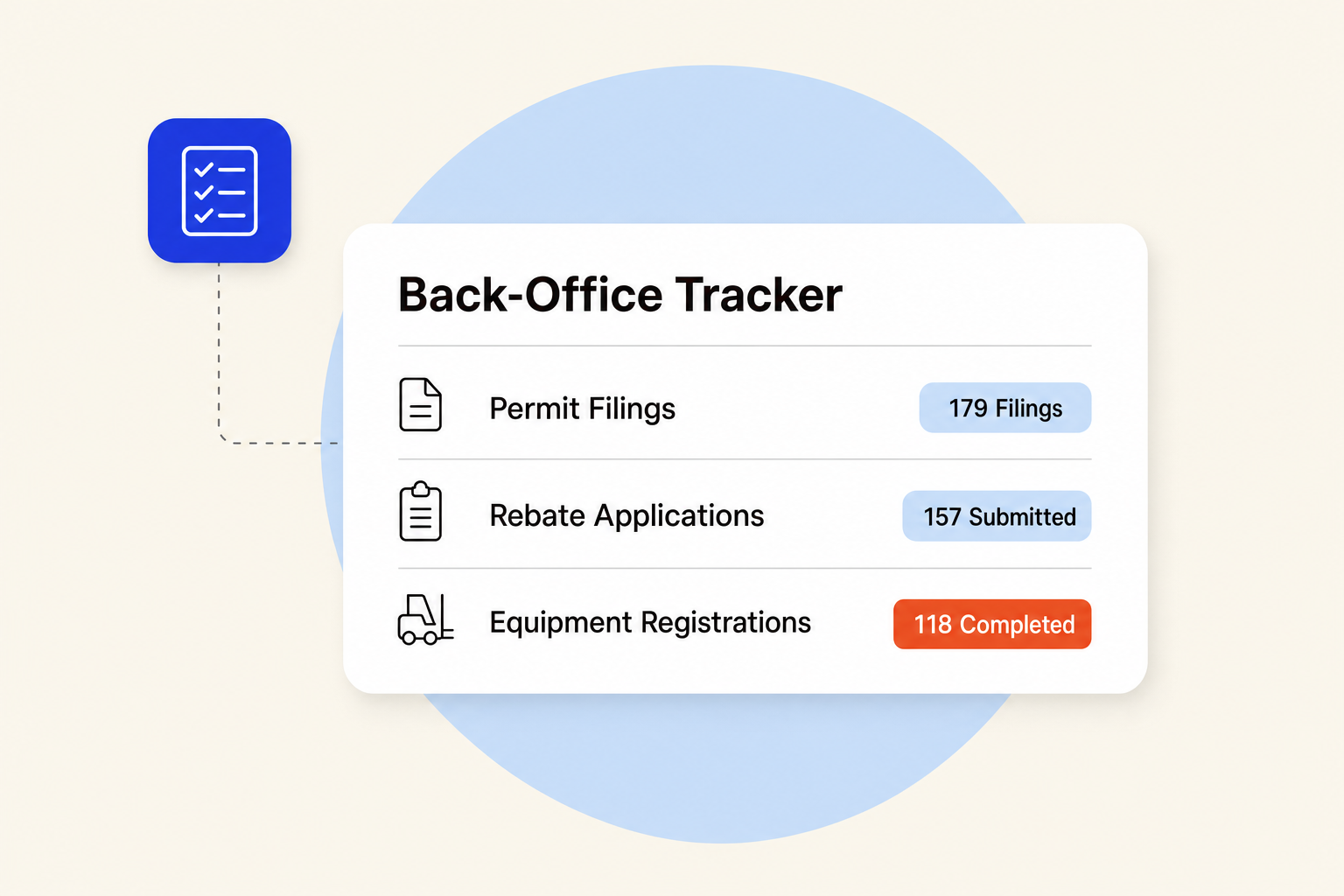
- Rebate applications: Utility and heat pump rebate programs require precise documentation, multi-portal submissions, and active follow-up. Veteran Heating, Cooling, Plumbing and Electric secured $845,927 in total rebate value with 157 applications submitted and a 85% permit approval rate across 179 filings in 20-plus jurisdictions.
- Equipment registrations: Manufacturer warranty registrations get filed at job closeout, including certificate generation and storage, so customers are covered and contractors aren't liable for missed deadlines. Veteran completed 118 equipment registrations across five product categories. Full details on permits, rebates, and equipment registrations.
- Customer follow-ups and weekly check-ins: Follow-up communications go out on schedule, and the owner gets a weekly status update on what's been handled, what's pending, and where there are gaps to address.
What Are Your Options for Contractor Business Support?
A 2 to 4 truck HVAC shop has four realistic categories of support to choose from. Each has a different pricing model, a different ownership structure, and a different ceiling on what it can actually handle.
The 2026 EGIA HVAC Contractor Survey report, which included 353 respondents from the US and Canada, consistently surfaces back-office and administrative burden as a top operational challenge for small contractors. The options below reflect what's actually available in the market, with honest trade-offs for each.
Virtual Office and Reception Services
- Pricing: AI-only answering runs $25 to $300 per month; live human answering runs $300 to $2,000-plus per month.
- What's included: Call answering, message taking, and in some cases a business mailing address.
- Who it fits: Owners who only need front-desk phone coverage and handle all back-office work themselves.
- Main trade-off: No back-office execution. Permits, billing, rebates, and registrations stay entirely on the owner's plate.
General Home-Services and Contractor VAs
- Pricing: Hourly rates typically range from $5 to $150 per hour, often with monthly minimums.
- What's included: Calendar management, inbox sorting, appointment booking, and basic dispatch support.
- Who it fits: Owners willing to train, direct, and manage the VA's daily workload.
- Main trade-off: The owner remains the manager. Work doesn't happen unless the owner assigns it, and HVAC-specific tasks like rebate portals or permit jurisdictions require significant training time.
Field Service Software Alone
- Pricing: Per-user fees typically run $13 to $400-plus per month depending on the platform and feature tier.
- What's included: Scheduling tools, dispatch boards, invoicing templates, and job tracking.
- Who it fits: Owners who want better tools and are willing to operate them personally.
- Main trade-off: Software doesn't file permits or submit rebates on its own. Someone still has to operate it, and if that someone is the owner, the admin burden doesn't actually decrease. See more on optimizing your field service management platform to get more out of what you're already paying for.
HVAC-Native Fully Managed Service
- Pricing: Month-to-month, typically in the $1,000 to $3,000 per month range depending on scope.
- What's included: Scheduling, invoicing, permits, rebates, equipment registration, customer follow-ups, weekly check-ins, and proactive flagging of workflow gaps.
- Who it fits: Owners running 2 to 4 trucks who are currently doing admin at night and want it off their plate entirely without hiring, training, or managing anyone.
- Main trade-off: Higher monthly baseline than a VA, but the work is owned end-to-end without the owner managing it. WorkHero is one example of this model, built specifically for HVAC contractors and operating inside the tools owners already use.
How Does Virtual Admin Work Inside Your Field Service Management Software?
A managed HVAC back-office service works inside the software you already run, not alongside it in a separate system. No platform migration, no duplicate data entry, no retraining your techs on new tools.
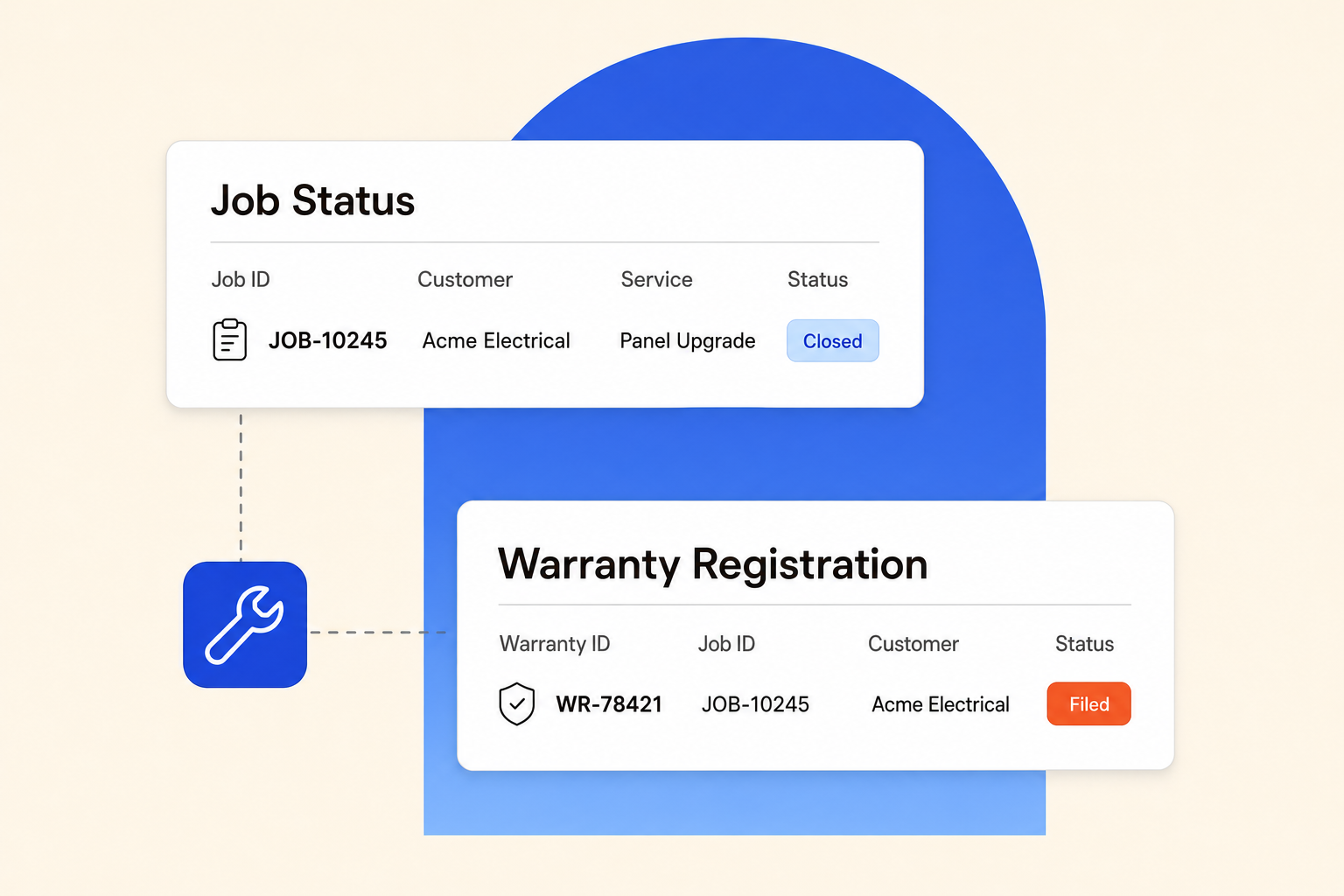
The integration goes beyond read-only access. When a job closes out in Housecall Pro, ServiceTitan, or Jobber, that event can trigger an equipment registration workflow automatically: the manufacturer warranty gets filed, the certificate gets generated and stored, and the registration status gets recorded directly in the job record. The owner doesn't have to initiate any of that. For more on how automation layers into this process, see AI and automation in HVAC back-office operations.
The human-in-the-loop model matters here. AI handles repetitive, document-heavy tasks like data entry, follow-up emails, and status tracking. The office manager handles approvals, edge cases, and anything that requires judgment, like a permit jurisdiction that pushes back or a rebate portal that changes its documentation requirements mid-season. That combination keeps work moving without sacrificing accuracy. If your current software setup isn't configured to support this kind of workflow, HVAC software setup and SOP development is typically where that work starts.
How Much Does Virtual Office Management Cost for a 2 to 4 Truck HVAC Shop?
Cost depends heavily on which model you choose and how much of the work you're still willing to own yourself. Here's how the three main options compare.
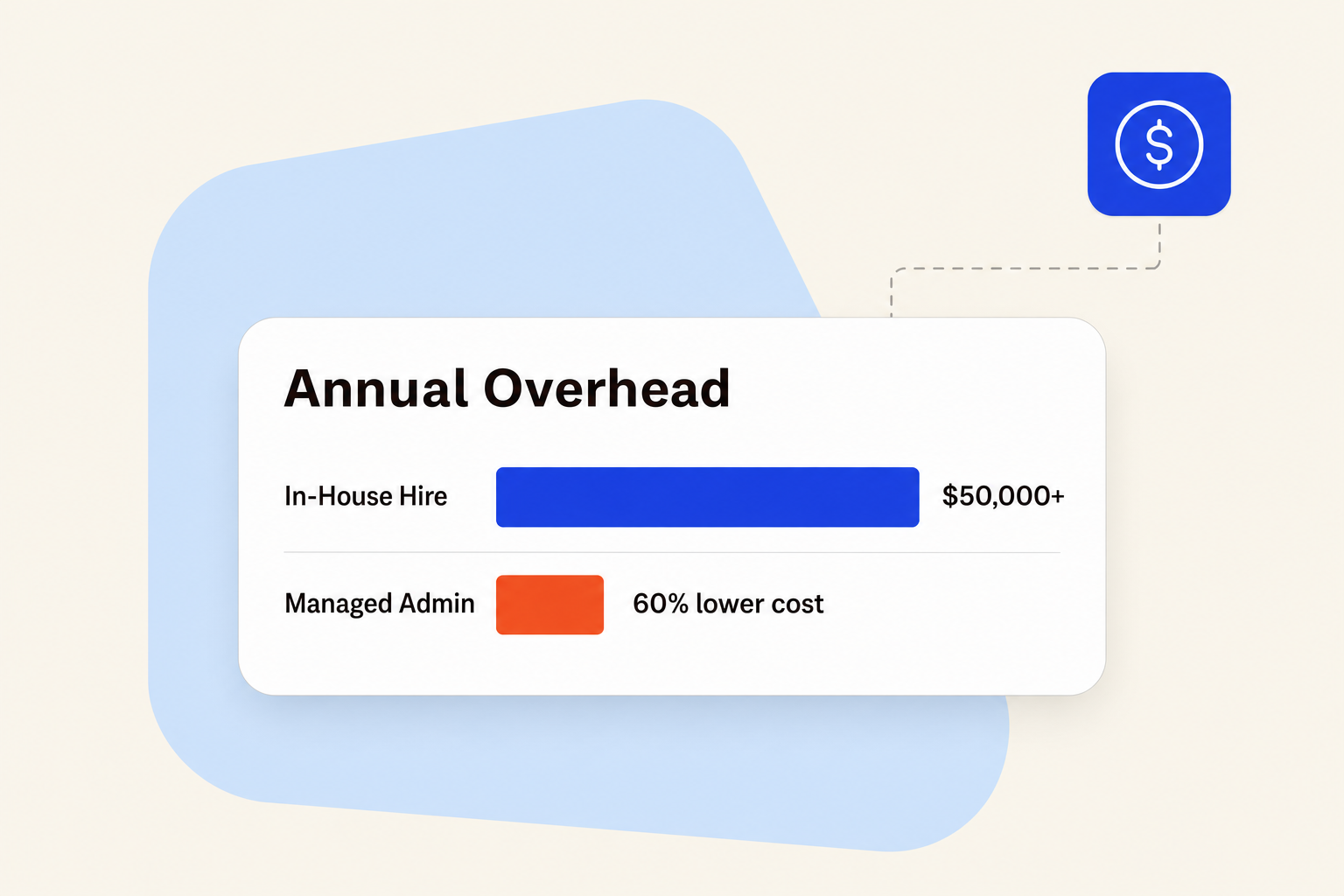
- Full-time office manager hire: A full-time in-house office manager typically costs $50,000-plus per year before benefits, recruiting costs, and training time. The main advantage is dedicated, on-site presence. The trade-offs are a high fixed cost, a ramp period of several months before the person is fully productive, and significant exposure if that person leaves. For a 2 to 4 truck shop, this is often more overhead than the business can absorb without a steady revenue base to support it.
- Hourly generalist VA: Rates range from $5 to $150 per hour depending on experience and specialty, often with monthly minimums. The total cost is unpredictable because it scales with how much work the owner assigns. The owner also spends time managing the VA's workload, which offsets some of the time savings. For HVAC-specific tasks, expect a meaningful training investment before the VA can operate independently.
- Month-to-month managed HVAC admin: Typically priced in the $1,000 to $3,000 per month range with no long-term contract and scope built around what the shop actually needs. The work is owned end-to-end, meaning the owner doesn't manage daily task assignment or quality control. Compared to a full-time in-house hire, this model runs at roughly 60% lower cost while covering the same core functions. Plans are month-to-month, so there's no commitment risk if the scope needs to change.
How Do You Know When It's Time to Get Help With HVAC Admin?
The clearest signal is when admin work keeps ending up back on the owner's desk regardless of what else is in place. These are the situations that typically indicate the current setup isn't working.
- You're doing admin at night or on weekends: If evenings and weekends are consistently spent on invoicing, rebate applications, or permit follow-ups, that's 15 to 20 hours a week that isn't going toward field work, customer relationships, or business development.
- Your software is underused or disorganized: Paying for Housecall Pro or ServiceTitan but not using the invoicing automation, job closeout workflows, or reporting features means the tools aren't doing the work they were built for.
- You're relying on a spouse, part-timer, or constant re-hiring: Informal admin arrangements create single points of failure. When that person leaves or isn't available, the backlog lands on the owner immediately.
- Paperwork keeps rolling back to you: If rebate applications, permit filings, or AR follow-ups consistently end up requiring your personal attention to move forward, the current process doesn't have real ownership built into it.
If more than one of these describes your current situation, the admin workload has likely outgrown what informal arrangements can handle. For a more detailed look at the specific thresholds, see signs your admin workload needs outside help. The weekly check-in model that comes with a fully managed service is also worth understanding as a maintenance mechanism, since it's what keeps the back office from quietly drifting back into disorganization once the initial backlog is cleared.
