

Key takeaways
- Repair volume is up sharply: Repair revenue share climbed from 21.6% to 31.3% of total HVAC revenue between 2021 and 2025, and repairs per organization grew 64.7% in the same window, meaning small shops are absorbing more repair volume without proportional admin capacity.
- Admin is the real constraint: Small HVAC companies are 6.5 times more likely than larger companies to cite admin work as their primary challenge, and fixing billing ownership alone took one 9-person shop's invoice volume up 700% in 30 days.
- The fix is operational, not structural: Plugging an experienced HVAC admin into your existing tools, whether Jobber, HouseCall Pro, QuickBooks, or ServiceTitan, delivers office-manager-level output without the cost, hiring, or training of a full-time employee.
Repair revenue now makes up nearly a third of total HVAC industry revenue, up from roughly a fifth just four years ago. That shift is already happening in your market, and it favors shops that can handle volume without the back office collapsing under the weight of it.
This article is based on How Slow Cash Flow for HVAC Owners is Killing Growth by Delayed Invoicing, an episode of the HVAC Know It All Business Edition podcast with Roland Ligtenberg, co-founder and SVP of Growth & Innovation at Housecall Pro. Over 13 years Roland has helped thousands of HVAC, plumbing, and electrical contractors move from pen and paper to modern field service software.
This article covers why small shops are positioned to win the repair economy, where the operational gaps actually are, and what it takes to close them, from billing ownership to rebate follow-through to knowing which four numbers to watch every week.
What Is the HVAC Repair Economy, and Why Are Small Shops Positioned to Win It?
The repair economy refers to a structural shift in how HVAC revenue is generated: less replacement-driven, more service-and-repair-driven. According to Housecall Pro, repair revenue share climbing since 2021 shows the move from 21.2% in Q4 2021 to 33.4% in Q4 2025, a gain of more than 12 percentage points. At the same time, repair volume up 64 percent per shop confirms that from 2022 to 2025, the average number of repair jobs per organisation per year grew 64.7 percent. With homeowners planning HVAC repairs in 2026 at 20%, demand isn't softening.
Small shops are well-positioned here because repair work is local, relationship-driven, and dispatched fast. A 2-to-4-truck operation can respond to a same-day call in ways a regional chain cannot. But the advantage only holds if the back office keeps pace with the field. When repair tickets per shop climb from roughly 800 to 1,200 over four years, the shop doing 3 to 4 repairs a day needs admin infrastructure that matches that pace, not an owner catching up on invoices at 10 p.m. Winning the repair economy is an operations problem, and supporting independent HVAC ownership depends on getting that distinction right.
Why Do Small HVAC Shops Lose Repair Jobs to Bigger Competitors?
Small shops lose repair jobs not because of price or skill, but because of response time and follow-up speed. The cost of missed repair calls is concrete: 27% of home-services calls go unanswered on average. When a homeowner calls three shops and yours goes to voicemail, the job goes to whoever picks up first.
The deeper issue is that small shops carry a disproportionate admin load. According to small HVAC business admin burden data, small HVAC companies are 6.5 times more likely than larger companies to cite administrative work as their primary challenge. Bigger companies have dedicated staff handling scheduling, dispatch, and follow-up. When the owner is also the person answering calls, sending quotes, and chasing invoices, response time suffers across all three.
The repair economy rewards whoever responds first. A missed call at 8 a.m. on a hot Tuesday is a missed job, and the customer who called won't wait. Fixing that isn't a marketing problem. It's a matter of having someone available to handle inbound calls and schedule the job while the tech is already on a roof. For local marketing that books repair jobs to pay off, the back office has to be ready to convert the calls it generates.
How Does Back-Office Admin Quietly Sink Profitable Repair Shops?
Rising repair volume without admin capacity compounds into cash-flow risk faster than most owners expect. Roland Ligtenberg, co-founder of Housecall Pro, put numbers on it on the HVAC Know It All Business Edition podcast:
"And what's really interesting is so we just released this new state of the homeowner report... the repair ticket... increased by 47% over the last four years... if you're doing 3 to 4 day plus an install, all of a sudden at the end of the week you're sitting on, if you didn't do it manually, you know you're sitting on probably 15 to 25. That you get to go bang out. That's going to take you a little while. That admin overhead is real collect when you can." Roland Ligtenberg, Housecall Pro
Fifteen to 25 un-invoiced jobs by Friday is not a hypothetical. At an average repair ticket of a few hundred dollars, that's several thousand dollars sitting in a backlog the owner has to clear over the weekend instead of resting or planning the next week. The fix isn't working harder on Saturdays. It's having a billing process that closes jobs in real time.
Where the Cash Actually Leaks
The specific points where profitable repair shops lose cash are well-documented. For a deeper breakdown, see where small shops lose cash. The four most common failure points are:
- No billing ownership: When a part-time office manager and a VA split invoicing responsibilities, neither has full accountability for accuracy, timing, or collections follow-through.
- Delayed invoicing: Jobs completed without same-day invoicing effectively extend credit to the customer. The standard should be: finished before noon, invoice out same day; finished after noon, invoice out next morning.
- Inherited Net 30 terms: Many shops default to Net 30 because it came pre-loaded in their field service software, not because it was a deliberate decision. Net 10, or due-on-receipt for residential work, pulls cash forward without damaging customer relationships.
- No collections escalation ladder: Sending an invoice is not the same as getting paid. A defined escalation (Day 1 receipt and reminder, Day 7/10 follow-up, Day 15 firm notice, Day 30+ final step) turns collections from a mood into a system.
How Can Small HVAC Shops Compete Without Hiring a Full-Time Office Manager?
Small shops can get office-manager-level output by plugging an experienced HVAC admin into their existing tools, without the cost or overhead of a full-time hire. The decision comes down to four options owners actually weigh.
The Three Alternatives Owners Actually Consider
- DIY (owner handles it): No added cost, but the owner absorbs every scheduling call, invoice, permit filing, and follow-up. At 3 to 4 repairs a day, this is the path to nights and weekends spent on paperwork rather than running the business.
- Full-time office manager hire: A dedicated person with clear ownership, but at $50K or more per year plus benefits, hiring time, onboarding, and the risk of starting over if they leave. For a 2-to-4-truck shop, the math rarely works until revenue justifies it.
- Generic virtual assistant: Lower cost, but a VA with no HVAC background needs constant direction on permit requirements, rebate portals, FSM software, and collections escalation. The owner ends up managing the VA instead of getting time back. For context on what AI tools for HVAC back office can and can't replace, the distinction between a trained admin and a general task-taker matters.
- Industry-specific back-office support: An admin who already knows Jobber, HouseCall Pro, QuickBooks, and ServiceTitan, understands HVAC billing cycles, and can take ownership of collections without being trained from scratch. Onboarding adapts to the shop's existing workflow rather than forcing a new one. For more on building the right infrastructure around that support, see the tech stack for repair-focused shops.
What Happens When Your HVAC Office Person Quits?
Losing your office person mid-season is one of the fastest ways a repair shop stalls. Scheduling, invoicing, and customer communication don't pause while you post a job listing and interview candidates.

Just Right Mechanical, a 9-person HVAC company, ran into exactly this situation. A part-time office manager left, and a VA handling miscellaneous admin had no clear ownership of billing or AR. The result:
- Invoices sat unissued: Completed jobs weren't converting to cash because no one had accountability for sending invoices on time.
- Follow-ups were reactive: Without a defined collections process, reminders went out inconsistently and payments came in slowly.
- AR visibility was limited: The team couldn't easily see what was billed, what was outstanding, or how long invoices had been aging.
After WorkHero took over billing end to end, Just Right Mechanical saw invoices issued increase by 700%, on-time payments improve by 138%, and payments arrive 48% faster compared to the prior 30 days. The turnaround didn't require new software or a new hire. It required someone with clear ownership and a defined process. That's the argument for not relying on a single person whose departure can stall the entire operation.
How Do Rebates, Permits, and Follow-Ups Turn Repair Jobs Into Repeat Business?
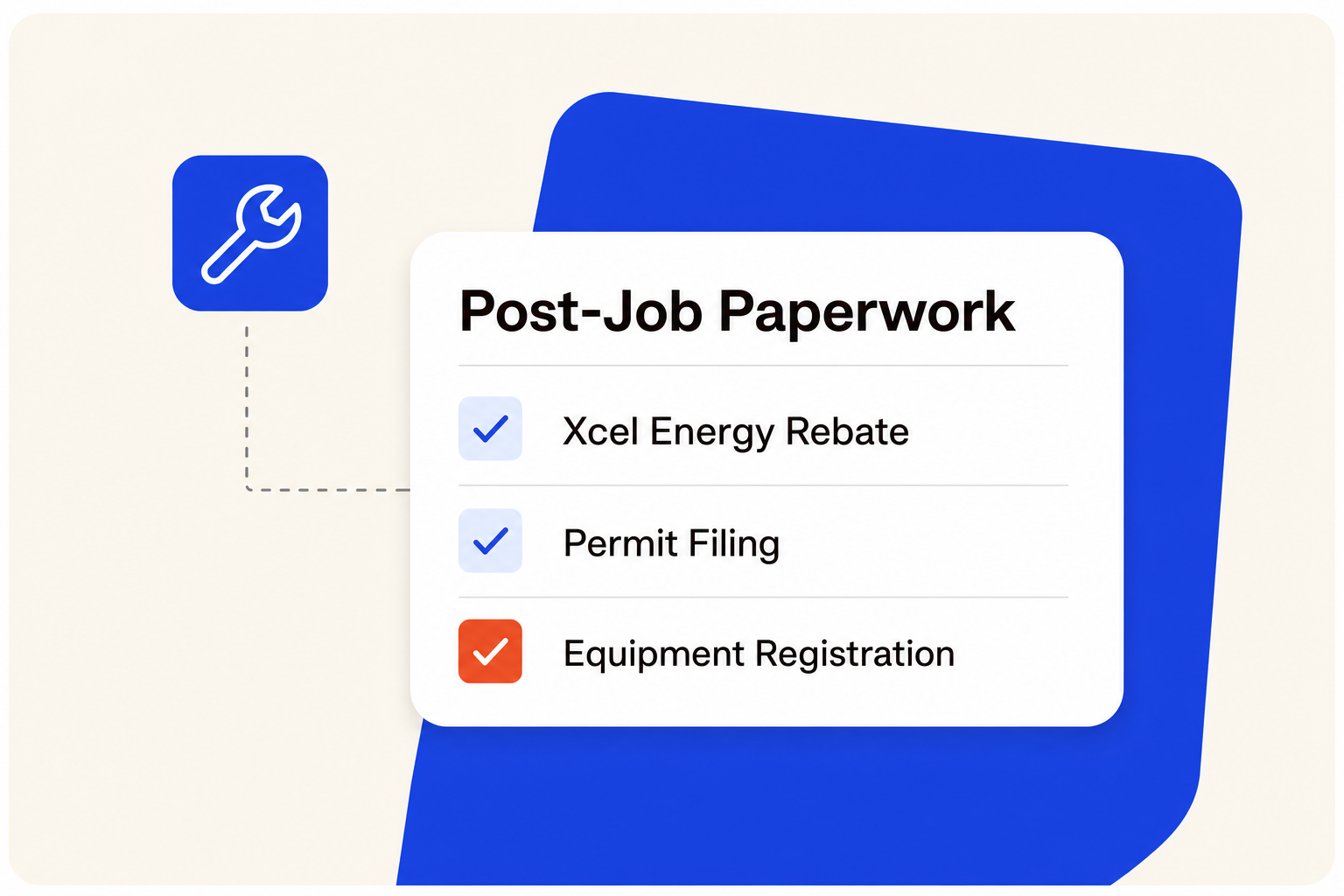
Rebates, permits, and equipment registrations are revenue drivers, not just compliance tasks. Veteran Heating, Cooling, Plumbing and Electric had $0 in tracked rebates before getting back-office support. After WorkHero took over post-job paperwork, Veteran secured $845,927 in total rebate value year-to-date, hit an 85% permit approval rate across 20-plus jurisdictions, and completed 118 equipment registrations. Those aren't administrative wins. They're dollars that existed in completed jobs and were previously going uncaptured.
The Follow-Up Tasks That Drive Repeat Business
- Rebate filing: Xcel Energy rebates alone can range from $2,000 to $13,000-plus per install. Capturing them requires precise documentation, multi-portal submissions, and active follow-up with program administrators. Most small shops don't have the bandwidth to manage it consistently.
- Permit tracking: Every jurisdiction has different forms, fee structures, and review timelines. Filing across 20-plus building departments without a dedicated process means permits get missed or delayed, which can stall final payment or create liability.
- Equipment registration: Manufacturer registration activates warranty coverage. Missed registrations leave customers exposed and can damage the relationship when a warranty claim gets denied later.
- Maintenance plan outreach: A repair job is the best time to convert a customer to a maintenance agreement. If no one follows up after the job closes, that opportunity expires. Consistent post-job outreach is what turns a one-time repair customer into recurring revenue.
How Do You Measure Whether Your Shop Is Actually Winning in the Repair Economy?
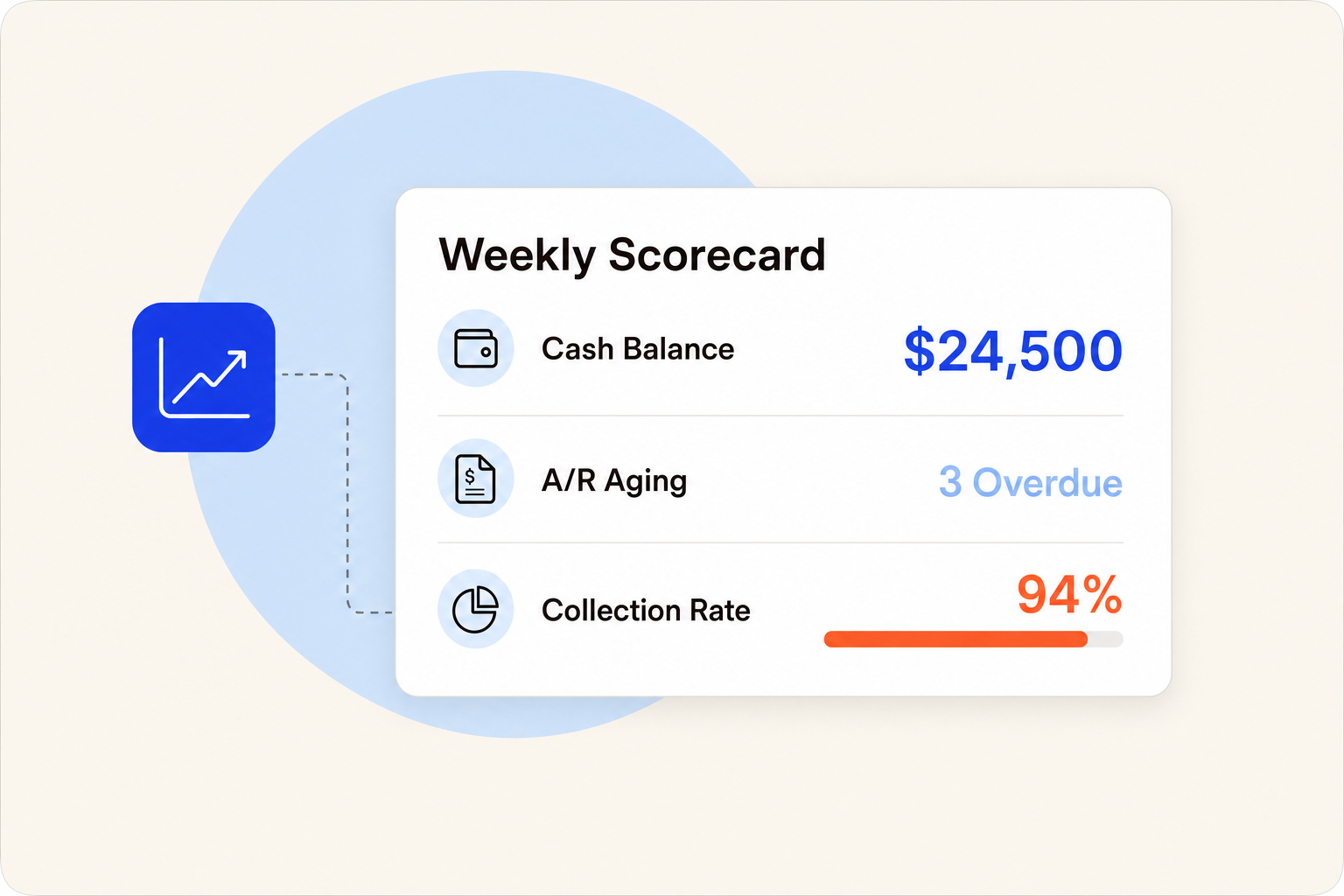
Four weekly numbers tell you whether your shop is capturing the repair economy or just staying busy. Your field service software records the raw data, but it won't interpret it or flag what needs attention. That's where a dedicated admin adds value beyond task execution.
Metrics Worth Tracking Weekly
The weekly scorecard that matters for a repair-focused shop covers:
- Cash balance (today, not last month): Revenue on paper doesn't pay payroll. Knowing your actual cash position weekly is the difference between making decisions and reacting to surprises.
- Accounts receivable aging: Who owes money, and how long has it been outstanding? An invoice at Day 8 needs a different response than one at Day 32. Without this view, collections defaults to a mood rather than a system.
- Invoice turnaround time (job done to invoice sent): This is the metric that most directly reflects billing discipline. A shop doing 3 to 4 repairs a day with a two-day invoice lag is financing its customers. Same-day invoicing is the standard worth measuring against.
- Collected dollars vs. billed dollars: Sending invoices and collecting payment are two different activities. This ratio shows whether your collections process is actually working or just generating paper.
For more on maximizing your field service software to surface these numbers automatically, the configuration matters as much as the data. And once you have cash flow visibility, pairing it with accurate job costing gives you the full picture. See building profit through job costing for how to connect field-level cost data to the weekly numbers you're tracking. The shops that win in the repair economy aren't necessarily the biggest. They're the ones that know their numbers on Monday morning, not after the accountant calls in April.
Listen to the Full Conversation
This article is based on Roland Ligtenberg's conversation with hosts Gary McCreadie and Furman Haynes on the HVAC Know It All Business Edition podcast (How Missed Calls Are Killing HVAC Owners to Unlock Millions in Revenue and How Slow Cash Flow for HVAC Owners is Killing Growth by Delayed Invoicing). You can find these episodes, and every other episode of the show, on YouTube, Spotify, and Apple Podcasts, or browse them all on the WorkHero HVAC Business Podcast page.
